|
|
 |
|||||||||||
 |
||||||||||||







Turtle Rescue of Long Island
|
|---|
|
Turtle Rescue of Long Island, which is a 501(c)3 non-profit
became incorporated in 2004, started by Julie Maguire and Steve
Menikos in an effort to help the many turtles and tortoises which
become injured or are found ill. For many years we also took in
non-native turtles and tortoises and adopted them to new homes.
However over the years the rescue grew and so did the number of
turtles and tortoises that came in, forcing us to concentrate on
just taking in rehabs. At this time due to space, monetary and
time constraints we will only be taking in native turtles.
The goal of Turtle Rescue of Long Island is to provide reliable, up to date information on the care of turtles and tortoises as well as provide a haven for native turtles until they can be released back to the wild. On the pages of this website we hope you will find the information you are looking for. We strive to provide the best possible information on all aspects of care of chelonians. You will find links to some of the best sites on the web for species specific care. If you can’t find something just send us an e-mail and we’ll try to find the info for you. (TurtlerescueLI@gmail.com) Many people buy a turtle or tortoise and know very little about their care and don’t realize how large or how long turtles and tortoises can live with proper care. We hope you will find the information you need on our site to keep a healthy turtle or tortoise. PLEASE NOTE: AS OF AUGUST 1ST, 2015, TRLI WILL NO LONGER BE TAKING IN NON-NATIVE TURTLES AND TORTOISES WHICH INCLUDES RED EARED SLIDERS. WE WILL CONTINUE TO DO ALL OF THE REHABILITATION WORK ON THE NATIVE TURTLES, HOWEVER NO LONGER CAN ACCOMMODATE UNWANTED PETS. PLEASE CHECK WITH YOUR LOCAL SHELTERS AND RESCUES FOR HELP WITH PLACEMENT. We take in many native turtles for rehabilitation. There are cases that can be anything from hit by car, illness, cruelty cases, neglect and abandoned. Whenever possible all native wildlife is returned to the wild as they should be, and in the case of not being able to be released are adopted to permanent homes. For more information on turtles and tortoises, join our Facebook pages or our groups.io page: https://www.facebook.com/TurtleRescueLongIsland https://www.facebook.com/groups/1617986292360692 https://groups.io/g/TurtleRescueLongIsland |
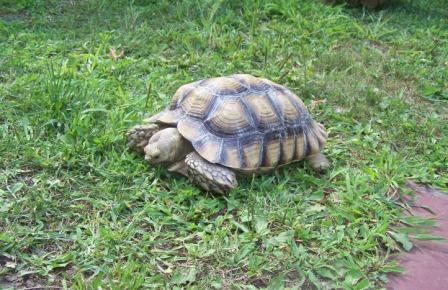 |
| Here in this yard... I will
never know the barriers of living in a glass
tank. I can sleep soundly, assured that when I wake my world will not have changed. I will never know hunger, or the fear of not knowing if I'll eat. I will not shiver in the cold, or grow weary from the heat. I will feel the sun's heat, and the rain's coolness, and be allowed to smell all that can reach my nose. My shell will be dirty because that's how a tortoise should be, not shiny from being waxed. Here in this yard... There will be an effort to communicate with me on my level. I will be talked to and, even if I don't understand, I can enjoy the warmth of the words. I will be given a name so that I may know who I am among many. My name will be used in joy, and I will love the sound of it! Here in this yard... I will never be a substitute for anything I am not. I will never be used to improve peoples' images of themselves. I will be loved because I am who I am, not someone's idea of who I should be. I will never suffer for someone's anger, impatience, or stupidity. Here in this yard... I can trust arms that hold, hands that touch... knowing that, no matter what they do, they do it for the good of me. If I am ill, I will be doctored. If scared, I will be calmed. No matter what I look like, I will be considered beautiful and known to be of value. I will never be cast out because I am too old, too ill, too unruly, or not cute enough. My life is a responsibility, and not an afterthought. I will learn that humans can, sometimes, be kind. Here in this yard... I will belong. I will be home. |
| |
|
|
|
|
|