|
Compiled by Julie
Maguire (licensed Wildlife Rehabilitator) of Turtle Rescue of Long
Island
Hypovitaminosis A is one of the
most common diagnoses in chelonians, and in most cases is a
misdiagnosis neglecting the true cause of swollen eyes, respiratory
system problems, and other outward symptoms. While Vitamin A
deficiency can be an underlying cause to the above health issues, in
particular turtles and tortoises fed deficient diets, with the
expansion of knowledge of husbandry and diet, hypovitaminosis A is
relatively uncommon and the diagnoses and treatment with injectable
Vitamin A is simply an outdated approach. If hypovitaminsis A is
suspected, the use of injectable Vitamin A supplements is often
given; the affects are often painful for the turtle or tortoise, can
cause internal organ failure because this Vitamin is fat soluble,
stored primarily in the liver, and in many cases death can occur.
Symptoms of Hypovitaminosis A
include: corneal epithelial dysfunction (inflammation), thinning of
the skin, and in more severe cases the skin will be raw resulting in
a potential for secondary infection. Large areas of sloughing will
likely occur with the potential of ulceration. In some cases of
Vitamin A deficiency, respiratory problems could also manifest
presenting with a runny nose due to the likely degeneration of the
lung tissue.
In the case of Hypervitaminosis A
(overdose) many of these same symptoms occur. Swollen eyes, skin
will present as thin with severe cases the skin sloughing exposing
rawness, sometimes ulceration, nails may fall off and in fatal cases
the beak may also fall off before the death of the animal.
If Hypovitaminosis A is suspected we
ask that all aspects of the Chelonians diet and habitat be explored,
and other health issues be considered and treated before the
consideration of aggressively treating the animal for Vitamin A
deficiency. In most cases dietary exploration and the addition of
food high in Vitamin A or beta-carotene will easily reverse this
deficiency. If the turtle or tortoise is not feeding, our
recommendation is to initiate tube feeding with species appropriate
foods. Also be sure in the case of turtles that need a humid
environment that they have the humidity required as lack of humidity
has time and again presented turtles with swollen eyes and has been
easily treated with simply raising the humidity in the enclosure.
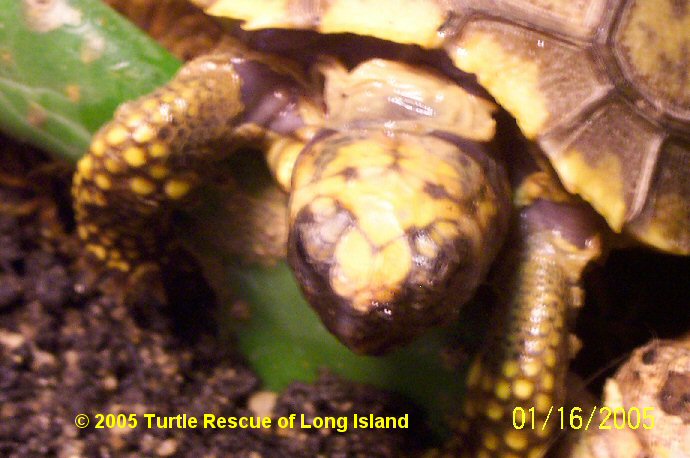
Below are just a
couple of pictures showing the effects of Hypervitaminosis A.
|
Yellowfoot
Tortoise hatchling |
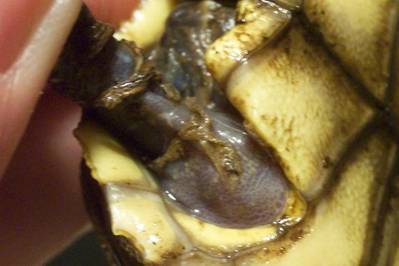
Yellowfoot Tortoise; close up of skin sloughing |
|
|
|
|
|
|
For further info read the article
by Dr. Chris Tabaka DVM:
http://www.chelonia.org/Articles/hypervitaminosisA.htm
I would also like
to add a warning about the use of Ivermectin for deworming turtles and
tortoises. This also has been found to be fatal in many Chelonian
species.
January 18, 2005 ~ Revised August 2008
© 2005 - 2008 Turtle Rescue of Long Island
|
|
All material herein © '2004-2025 "Turtle Rescue of Long Island ". All Rights Reserved
| |